Corporate Identities
"In the company's eyes, you aren't a person. You are a set of functions waiting to be optimized or discarded."
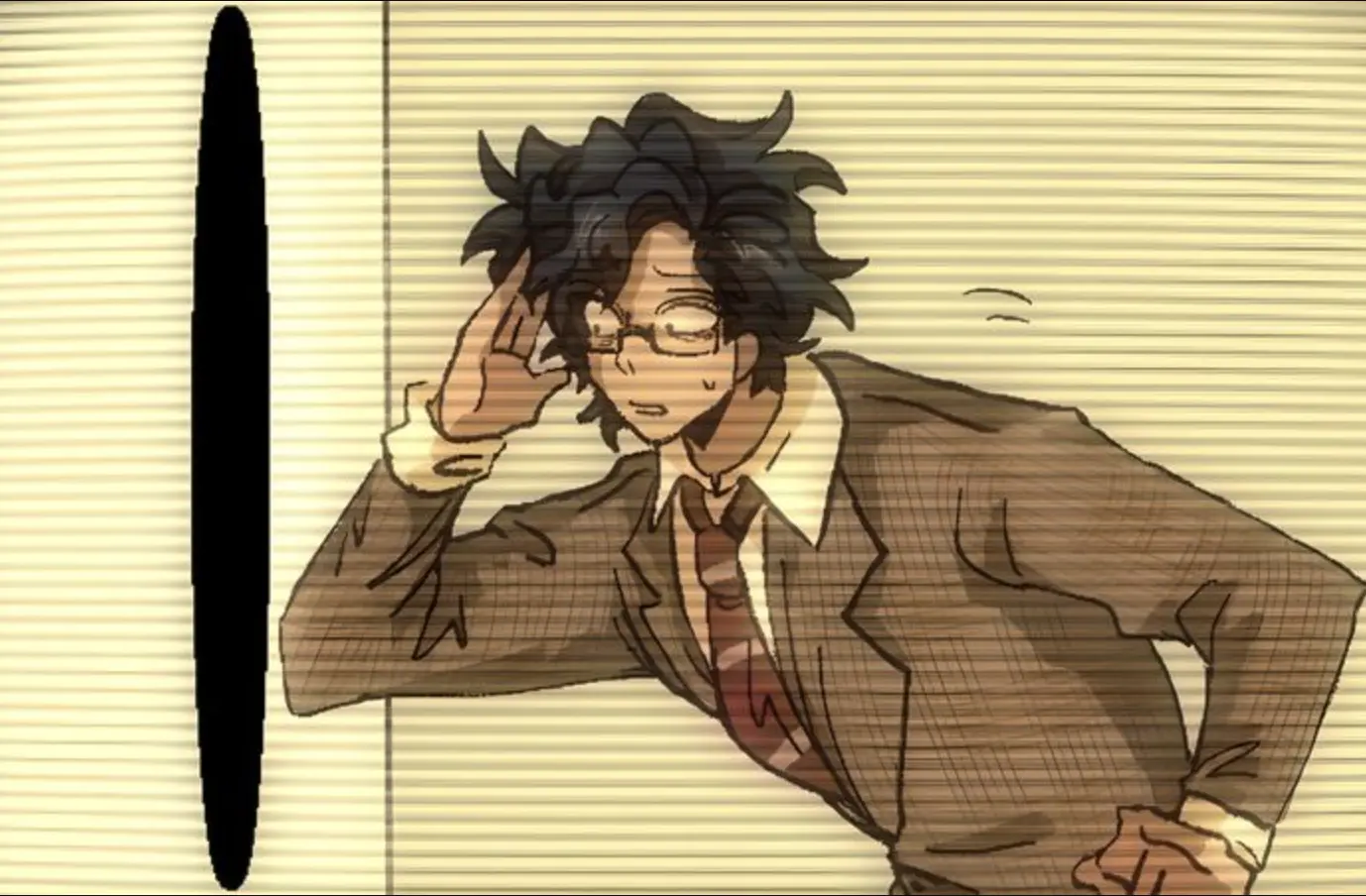
The Protagonist
The Subject (UB)
👁️ Visual Coding
- Red Dialogue: Encodes high social anxiety and vulnerability
- Minimalist Pixel Art: Evokes a sense of corporate disposability
- Muted Attire: 1970s corporate uniformity that strips individuality
- Meek Posture: A visual representation of bureaucratic oppression
🧠 Psychological Profile
- Memory Retention: The only entity aware of previous loop deaths
- Introspective: Constantly questions his own reality and humanity
- Decisive: Capable of extreme pragmatism when survival is at stake
- Isolated: Lacks any external safety net or personal history
The unnamed protagonist, often referred to as "UB" (Unassuming Bureaucrat), is a masterclass in liminal character design. Unlike typical horror protagonists, his fear isn't just external—it's existential. His visual coding is deliberately unremarkable, utilizing 2.5D sprites that suggest he is a cog in a much larger, meat-grinding machine.
Throughout the loops, we witness the erosion of his innocence. While he begins as a meek interviewee, the narrative demands he become a survivor. On Floor 8, the protagonist faces the ultimate moral litmus test: his willingness to sacrifice alternate versions of himself to secure progress. This suggests that the "True Ending" isn't an escape from the building, but a successful assimilation into its cold, corporate logic.
🎨 The Aesthetic of Compliance
The character designs leverage a 70s-80s retro-office aesthetic to mask psychological horror behind visual simplicity. The faux-wood paneling of the elevator and the muted oranges of the attire create a false sense of "normalcy" that slowly decays into organic, fleshy surrealism.
This visual limitation—the inability of pixel art to express complex facial horror—becomes a narrative feature. It mirrors the psychological numbing of the characters as they descend deeper into the building's impossible geometry.

Bryce Stryker
The Corporate Interface
👁️ Visual Coding
- Teal Dialogue: Clinical, detached, and emotionally distant
- Catalog Perfection: A handsome but mask-like salesman aesthetic
- Shifting Identity: Names change (Chase, Bryce, Clayton) based on rank
- Inverted Vulnerability: Polished appearance hiding a hollow core
🧠 Psychological Profile
- Selective Amnesia: Claims no memory of deaths to gaslight the player
- Hierarchical Dominance: Constantly interrupts and patronizes
- Ambiguous Intent: Oscillates between helpful ally and lethal hazard
- Disposable Tool: A manufactured consciousness serving the company
Bryce Stryker represents the corporate success archetype: polished, confident, and fundamentally hollow. He is the "Senior Employee" who guides you, but he is also your primary obstacle. His name-shifting nature suggests that in this bureaucracy, names are just labels for interchangeable assets.
His behavior varies wildly across floors, mapping a slow descent from "helpful coworker" to "corporate apparatus." As the floors transition from mundane offices to fleshy, biological nightmares, Bryce’s humanity erodes until he is revealed to be nothing more than a Turing Test construct designed to measure your compliance.
| Floor | Persona Shift | Subtext / Theory |
|---|---|---|
| Lobby | Overconfident Talker | Interrupts intro; establishes dominance. |
| Floor 2-3 | Mocking & Unhelpful | Refuses to help; questions your reality. |
| Floor 8 | The Litmus Test (Fatal) | Splits into "Hostile" or "Ally" depending on Trust. |
| Floor 9 | The Tool | Disappears instantly upon "Escape". |
The Core Enigma: What is Bryce?
📂 The Manufactured Tool
Evidence from the Floor 9 boss suggests Bryce was never human. He is a 'provided tool'—a sophisticated AI interface bound to the elevator's logic. His disappearance after the Escape Ending supports his status as a task-oriented subroutine.
📂 The Consumed Employee
A darker theory suggests Bryce was once a real hire. Having been 'Employee of the Month' but now dismissive of his own name, he represents the final stage of corporate assimilation: a soul-less ghost trapped in a permanent cycle.
📂 The Doppelgänger Paradox
Floor 8 introduces a 'quiet, humanized' version of Bryce. This suggests the company mass-produces employees, and the 'real' versions are those who have been broken and discarded in the parallel dimensions of the building.
📂 The Building's Limb
Some fans believe Bryce is part of the elevator itself. Since the building is revealed to be organic and sentient, Bryce functions as its tongue—the interface used to communicate with and digest new prey.
The Tragedy of Mutual Complicity
The relationship between Bryce and the Protagonist isn't a story of friendship; it's a study in capitalist alienation. In the beginning, Bryce dominates the power dynamic. By the middle floors, he becomes a burden, and the protagonist must become the "operative" to survive.
This role reversal culminates on Floor 8, where hierarchy is revealed as a false construct. Both are trapped rats. The game’s central thesis suggests that cooperation within a rigid hierarchy is impossible—you either dominate or you submit. Even the "True Ending" is a loop, suggesting that once you enter the building, there is no genuine exit from the system.